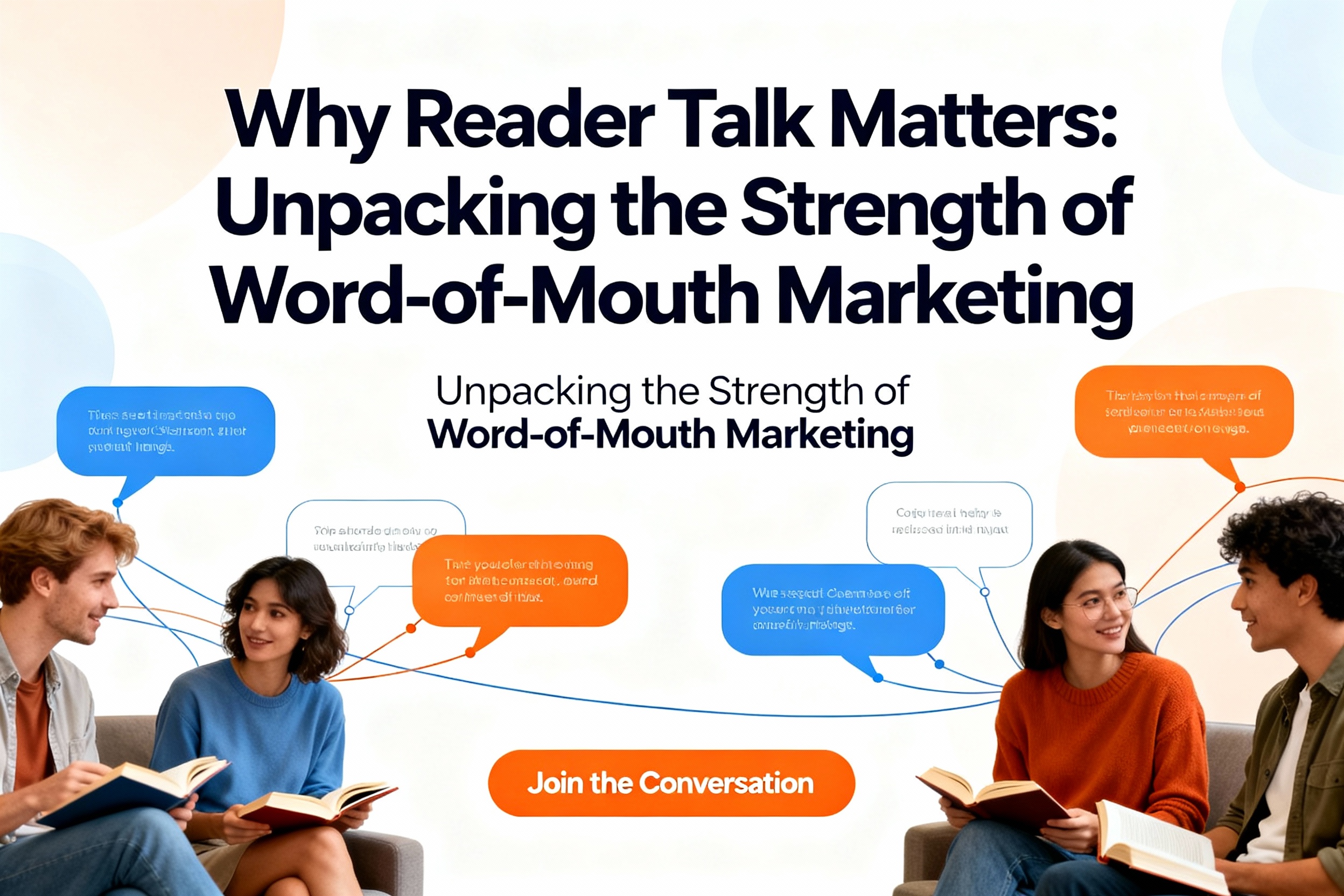
Why Reader Talk Matters: Unpacking the Strength of Word-of-Mouth Marketing
In an age saturated with targeted ads, sponsored content, and algorithmic recommendations, one marketing force remains remarkably potent and refreshingly authentic: word-of-mouth. When a friend leans across the table and says, “You have to read this book,” that recommendation carries more weight than a thousand banner ads or a carefully crafted social media campaign. For authors, publishers, and anyone in the book industry, understanding why reader talk matters—and how to cultivate it—represents the difference between obscurity and breakthrough success.
Word-of-mouth marketing isn’t new. It’s arguably the oldest form of marketing, predating written language itself. Yet in today’s digital ecosystem, where everyone has a platform and influence is democratized, word-of-mouth has evolved into something more powerful and measurable than ever before. This deep dive explores why reader conversations drive book sales, how organic recommendations create sustainable success, and practical strategies for sparking the reader talk that can transform a book’s trajectory.
The Psychology Behind Word-of-Mouth Power
To understand why word-of-mouth marketing works so effectively, we need to examine the psychological mechanisms that make personal recommendations uniquely persuasive.
Trust is the foundation. When your friend recommends a book, you’re not just receiving information about a product—you’re receiving a signal filtered through someone whose judgment you trust. This trusted intermediary has already assessed whether the book aligns with your tastes, interests, and values. They’ve done the vetting work that you’d otherwise need to do yourself through reviews, sample chapters, and synopsis evaluation.
Research consistently shows that consumers trust recommendations from people they know far more than any form of advertising. Nielsen studies have found that 92% of consumers trust recommendations from friends and family above all other forms of marketing. For books specifically, this trust factor is even more pronounced because reading represents a significant time investment. Nobody wants to waste hours on a disappointing book, so recommendations from trusted sources become essential navigation tools in an overwhelming marketplace.
Social proof amplifies decision-making confidence. When multiple people in your network recommend the same book, it creates a bandwagon effect. You start to feel that everyone’s reading it, discussing it, and you’re missing out. This fear of missing out (FOMO) is a powerful psychological motivator that drives people to seek out books that have achieved word-of-mouth momentum.
Book clubs exemplify this principle perfectly. When your book club selects a title, you’re not just individually choosing to read it—you’re participating in a collective experience that will be discussed and dissected. This shared reading experience creates accountability and anticipation that individual reading often lacks.
Emotional connection drives sharing. People don’t recommend books because they meet objective quality criteria; they recommend books that made them feel something profound. Whether that’s laughter, tears, inspiration, terror, or wonder, emotional resonance is what transforms readers into advocates. When a book touches something deep within us, we feel compelled to share that experience, hoping to give others the same emotional gift we received.
This emotional component explains why word-of-mouth often succeeds where traditional marketing fails. An advertisement can tell you a book is “the thriller of the year,” but it can’t replicate the genuine enthusiasm in your friend’s voice when they say, “I stayed up until 3 AM because I couldn’t put it down.” That authentic emotional testimony carries immeasurable persuasive weight.
The Economics of Reader Talk
Beyond psychology, word-of-mouth marketing possesses economic advantages that make it particularly valuable in the book industry’s challenging landscape.
Cost-effectiveness is unparalleled. Traditional advertising requires substantial budgets—purchasing ads, designing campaigns, targeting audiences. Word-of-mouth marketing, by contrast, happens organically with minimal financial investment. When readers become passionate advocates for your book, they’re essentially volunteering as your marketing team, spreading awareness through their personal and digital networks without compensation.
This doesn’t mean word-of-mouth is entirely “free”—authors and publishers invest in creating quality products, building reader relationships, and sometimes providing advance copies or organizing events that facilitate conversation. But the return on investment for successful word-of-mouth far exceeds traditional advertising channels.
Longevity creates sustained success. Advertising campaigns are temporal. You buy a promotion, it runs for a set period, and then it’s over. The sales bump you get typically disappears shortly after the campaign ends. Word-of-mouth, however, has remarkable staying power. A book that achieves genuine word-of-mouth momentum can sustain sales for months or even years as recommendations ripple through social networks.
Consider the phenomenon of “sleeper hits”—books that didn’t explode immediately upon release but gradually built audiences through reader recommendations. These books often achieve greater long-term success than heavily promoted titles that spike and then fade. The gradual build demonstrates that word-of-mouth creates durable, sustainable sales rather than temporary bumps.
Viral potential offers exponential reach. In the digital age, word-of-mouth has acquired viral characteristics. A single reader’s social media post about a book can reach hundreds or thousands of people. When that post gets shared, commented on, and reposted, it can exponentially multiply its reach. Hashtag campaigns like #BookTok have demonstrated how reader enthusiasm can catapult obscure titles to bestseller status virtually overnight.
This viral potential means that cultivating even a modest initial group of passionate readers can lead to outsized results if those readers are active in online book communities and have engaged social networks.
The Digital Transformation of Word-of-Mouth
While word-of-mouth has always been powerful, digital platforms have transformed how reader recommendations spread and amplified their potential impact.
Social media democratizes influence. You no longer need to be a professional book reviewer or literary critic to influence purchasing decisions. An enthusiastic reader with a few hundred Instagram followers can generate meaningful buzz. TikTok’s BookTok community has become particularly influential, with reader recommendations regularly sending books—sometimes decades-old titles—back onto bestseller lists.
These platforms lower the barriers to participation in literary conversations. Readers can share quick reactions, post aesthetically pleasing book stacks, create video reviews, or simply use hashtags to join broader discussions. Each of these actions contributes to the ambient awareness that drives word-of-mouth momentum.
Online book communities create concentrated enthusiasm. Goodreads, with its millions of users, represents a vast ecosystem of reader recommendations. When a book accumulates thousands of ratings and reviews with high averages, it creates powerful social proof that influences browsers’ decisions. The site’s recommendation engine then amplifies this effect by suggesting well-reviewed books to users with similar tastes.
Reddit’s book-focused subreddits, Facebook reading groups, Discord servers dedicated to specific genres—all of these represent concentrated communities where passionate readers congregate and share recommendations. For authors, having your book discussed enthusiastically in these spaces can be more valuable than traditional media coverage.
Online reviews serve as perpetual word-of-mouth. Amazon reviews, Goodreads ratings, and blog reviews function as persistent recommendations accessible to anyone researching a book. Unlike a conversation with a friend that happens once, online reviews remain indefinitely, continually influencing new potential readers.
The cumulative effect of many positive reviews creates legitimacy and trust. Readers may not know the individual reviewers personally, but the aggregated opinion of hundreds of readers serves a similar trust-building function as a personal recommendation. This is why review count matters as much as average rating—a book with 5,000 four-star reviews feels more trustworthy than one with five five-star reviews.
The Authenticity Imperative
As word-of-mouth has become recognized as valuable, some brands have attempted to manufacture or manipulate it. These efforts typically backfire because authenticity is non-negotiable in effective word-of-mouth marketing.
Readers detect inauthenticity. Fake reviews, paid influencer posts that feel scripted, or orchestrated campaigns that lack genuine enthusiasm are usually transparent to readers. The modern consumer has developed sophisticated detection mechanisms for inauthentic marketing, and discovery of manipulation can permanently damage an author’s reputation and a book’s potential.
The key distinction is between facilitating word-of-mouth (creating conditions that make it easier and more likely) versus fabricating it (artificially creating the appearance of organic recommendations). The former is ethical and effective; the latter is neither.
Genuine passion cannot be faked. When readers truly love a book, their enthusiasm shines through in their recommendations. They use specific details, share personal reactions, and communicate in natural language that reflects real human emotion. This authenticity resonates with potential readers in ways that polished marketing copy cannot.
Authors who focus on writing books that genuinely move readers, then build authentic relationships with their audience, create sustainable word-of-mouth engines. Those who focus primarily on manipulation tactics may achieve short-term gains but sacrifice long-term trust and loyalty.
Strategies for Cultivating Reader Talk
While you cannot force word-of-mouth, you can create conditions that make it more likely. Here are evidence-based strategies for encouraging reader conversations about your book.
Write a remarkable book. This may seem obvious, but it bears emphasizing: word-of-mouth begins with a product worth talking about. “Remarkable” literally means worthy of remark—something distinctive enough that readers feel compelled to discuss it. This might mean exceptional prose, an ingenious plot twist, unforgettable characters, or emotional resonance that lingers long after the final page.
Focus less on meeting market expectations and more on creating genuine emotional experiences. Books that play it safe rarely generate passionate word-of-mouth because they don’t give readers anything distinctive to discuss.
Identify and nurture your early adopters. Every successful word-of-mouth campaign begins with a core group of enthusiastic early readers. These might be advance review copy recipients, newsletter subscribers, beta readers, or members of your online community. Invest time in building relationships with these readers—not transactionally, but genuinely.
When you treat early readers as valued partners in your book’s journey rather than marketing tools, they become authentic advocates who enthusiastically share your work because they feel personally connected to it and to you.
Make it easy to share. Reduce friction in the sharing process. This might mean creating shareable graphics for social media, providing sample chapters that readers can easily forward, crafting compelling book descriptions that encapsulate what makes your book special, or offering exclusive content that readers can share with friends.
On social media, consider creating a unique hashtag for your book that readers can use to share their reactions and connect with other readers. Monitor these hashtags and engage with readers who use them—this recognition encourages continued advocacy.
Create conversation starters. Books that raise questions, challenge assumptions, or explore complex themes give readers more to discuss than plot-driven entertainment (though entertainment value certainly helps too). Consider including discussion questions at the end of your book, or creating companion materials that facilitate deeper engagement.
Book clubs represent concentrated word-of-mouth opportunities. Making your book “book club friendly”—with thematic richness, discussion potential, and perhaps author engagement opportunities—can help it gain traction in these influential reading communities.
Leverage timing and relevance. Books that connect to current conversations, trending topics, or cultural moments often generate more word-of-mouth because readers can easily connect them to broader discussions happening in their social circles. While you shouldn’t chase trends superficially, being aware of the cultural context your book enters can help you position it in ways that facilitate conversation.
Build a platform for ongoing engagement. Word-of-mouth doesn’t end when someone finishes your book; it can be sustained through continued engagement. A newsletter that provides value beyond self-promotion, an active social media presence where you engage authentically with readers, or a community space where readers can connect with each other—all of these extend the conversation beyond the initial reading experience.
When readers feel they’re part of a community rather than just consumers of your product, they’re more likely to become active advocates who recruit others into that community.
Encourage and showcase user-generated content. When readers create content about your book—reviews, fan art, social media posts, videos—acknowledge and celebrate it. This recognition encourages further content creation and demonstrates to other readers that their contributions are valued.
Consider featuring reader reviews on your website, sharing reader posts on your social channels (with permission), or highlighting creative responses to your work. This creates a positive feedback loop where readers see that their voice matters, encouraging both continued advocacy and attracting new participants.
Measuring Word-of-Mouth Impact
Unlike traditional advertising with clear metrics, word-of-mouth can be challenging to measure precisely. However, several indicators help you assess its impact.
Sales patterns reveal word-of-mouth momentum. While paid advertising typically creates sharp spikes followed by returns to baseline, word-of-mouth generates gradual, sustained growth. If your sales steadily climb week over week without corresponding promotional spend, word-of-mouth is likely at work.
Social listening provides qualitative data. Monitor social media mentions, hashtag use, and online discussions about your book. Tools like Google Alerts, social media monitoring platforms, or simply manual searches can reveal where and how readers are discussing your work. The tone, frequency, and spread of these conversations indicate word-of-mouth strength.
Review velocity matters. A healthy, sustained flow of new reviews on Amazon, Goodreads, and book blogs suggests readers continue discovering and engaging with your book. Pay attention not just to review count but to review timing—consistent new reviews over months indicate ongoing word-of-mouth rather than launch-period enthusiasm.
Traffic sources tell stories. If you track website analytics or use author-specific platforms, examine where traffic comes from. High proportions of social media traffic, direct traffic (suggesting people specifically sought you out), or referrals from book community sites indicate word-of-mouth activity.
The Long Game of Reader Relationships
Perhaps the most important insight about word-of-mouth marketing is that it’s not a tactic but a relationship-building practice. Authors who view readers as mere consumers to be converted miss the essence of what makes word-of-mouth powerful.
The most successful authors in the word-of-mouth ecosystem are those who genuinely care about their readers, create work with integrity and emotional honesty, and build authentic communities around shared love of storytelling. They understand that today’s reader might be tomorrow’s advocate, and that advocacy is earned through quality, authenticity, and mutual respect.
This long-term perspective requires patience. Word-of-mouth builds gradually, sometimes frustratingly so. A book might not explode immediately upon release but instead accumulate advocates steadily over months or years. Authors who persist in creating quality work and nurturing reader relationships often find that this patient approach yields more sustainable success than aggressive short-term tactics.
Conclusion: The Irreplaceable Human Element
In an increasingly automated, algorithm-driven marketing landscape, word-of-mouth remains stubbornly, beautifully human. It cannot be entirely systematized or automated because it depends on genuine human connection, emotion, and trust.
For authors, this human element is both challenge and opportunity. The challenge is that you cannot control or completely predict word-of-mouth success. The opportunity is that by focusing on what has always mattered—writing books that move people, treating readers with respect and authenticity, and building genuine communities—you create conditions where powerful word-of-mouth becomes not just possible but probable.
Reader talk matters because it represents the highest form of marketing: one reader enthusiastically telling another about something they loved. In a world of noise and manipulation, these authentic human recommendations cut through with remarkable efficiency. For authors willing to play the long game, invest in craft, and build authentic reader relationships, word-of-mouth remains the most powerful marketing force available—no advertising budget required.