
Morning Whispers: Embracing Each Day with Mindful Intention

There is something sacred about the early morning hours—a stillness that wraps around the world before it fully awakens. In those quiet moments, when darkness softens into light and the day hasn’t yet made its demands, we have an opportunity to set the tone for everything that follows. These are the morning whispers: gentle invitations to pause, reflect, and intentionally choose how we want to meet the day ahead. In our hurried modern lives, mornings often become a frantic race against the clock. We jolt awake to alarms, immediately reach for our phones, and launch into a cascade of tasks and obligations before our minds have fully emerged from sleep. We gulp coffee while checking emails, dress hastily, and rush out the door already feeling behind. By mid-morning, we’re exhausted, reactive, and wondering why each day feels like survival rather than living. But what if there was another way? What if the morning hours, rather than being something to rush through, could become a sanctuary—a deliberate practice of beginning each day with presence, purpose, and peace? This is the invitation of mindful morning intention: to transform those early hours into a foundation that sustains and nourishes us throughout the entire day. The Power of How We Begin The way we begin our day matters far more than most of us realize. Neuroscience reveals that our brains are particularly receptive in the morning, with heightened neuroplasticity that makes us more open to forming new patterns and perspectives. The state of mind we cultivate in the first hour often determines the quality of our thoughts, emotions, and responses for the next twelve hours. When we start our day in a reactive state—jumping immediately into emails, social media, or the news—we condition our nervous system to operate in fight-or-flight mode. Our attention becomes fragmented, our stress hormones elevate, and we lose agency over our own experience. We become responders rather than creators of our day. Conversely, when we begin with intention and presence, we activate different neural pathways. We engage our prefrontal cortex, the brain region associated with conscious choice, self-regulation, and wise decision-making. We create space for creativity, compassion, and clarity. We remember that we have sovereignty over our internal experience, even when external circumstances feel beyond our control. The morning whispers are those quiet invitations to choose the latter path—to reclaim our mornings as a practice of conscious living. Creating Your Sacred Morning Space Embracing each day with mindful intention begins with creating an environment that supports presence and peace. This doesn’t require a dedicated meditation room or elaborate setup. What matters is cultivating a sense of sanctuary in whatever space you have. Find a spot in your home—perhaps a corner of your bedroom, a comfortable chair by a window, or even a cushion on the floor—that can become your morning anchor point. This physical consistency signals to your brain that this is a time and place for presence and reflection. Over time, simply sitting in this space will help shift your consciousness toward a more mindful state. Consider what elements help you feel grounded and present. Some people are drawn to simplicity and minimalism, while others appreciate symbolic objects like candles, plants, meaningful photographs, or inspirational texts. The aesthetic matters less than the feeling it evokes. Does this space invite you to slow down, breathe deeply, and arrive fully in the present moment? Light plays a profound role in our morning experience. Rather than immediately flooding your space with harsh artificial light, consider welcoming the day more gradually. Open curtains to natural light if possible, or use soft lamps that mimic the gentle quality of dawn. This subtle transition honors your body’s natural circadian rhythms and creates a more peaceful awakening. The Architecture of a Mindful Morning While there’s no single “right” way to structure a mindful morning practice, certain elements consistently support presence and intention. Think of these as building blocks you can arrange according to your own needs, preferences, and time constraints. Gentle Awakening: Rather than jolting awake to a harsh alarm, experiment with gentler wake-up methods. Natural light alarm clocks that gradually brighten, soft music or nature sounds, or even training yourself to wake naturally can dramatically shift your morning experience. If you must use an alarm, choose a sound that doesn’t trigger stress and place your phone across the room so you’re not tempted to immediately scroll. Hydration and Nourishment: Before reaching for coffee, drink a glass of water. Your body has gone hours without hydration, and this simple act supports digestion, circulation, and mental clarity. Some people enjoy warm lemon water or herbal tea as part of their morning ritual, savoring the warmth and intentionally beginning the day by nourishing themselves. Movement and Breath: Our bodies need movement to fully awaken. This doesn’t require an intense workout—gentle stretching, a few yoga poses, or simply moving through your space with awareness can be enough. Pair movement with conscious breathing, perhaps taking several rounds of deep belly breaths to oxygenate your system and signal to your nervous system that you’re safe and present. Stillness and Silence: Even five minutes of sitting in silence can transform your day. You might practice formal meditation, focusing on your breath or using a guided meditation app. Or you might simply sit with your morning tea, watching thoughts arise without engaging them, noticing sensations in your body, or observing the quality of light outside your window. This practice of non-doing creates a counterbalance to the constant doing that will fill the rest of your day. Gratitude and Reflection: Before your mind fills with tasks and obligations, take a moment to acknowledge what you’re grateful for. This practice has been shown to increase wellbeing, resilience, and life satisfaction. You might keep a gratitude journal, mentally noting three things you appreciate, or simply allowing a feeling of thankfulness to wash over you. This practice reorients your mind toward abundance rather than scarcity, possibility rather than limitation. Intention Setting: The morning whispers ask: Who
Crafting Your Writer Identity: Stand Out in a Crowded Market
In today’s publishing landscape, millions of books compete for reader attention. Amazon alone hosts over 30 million titles, with thousands more added daily. Traditional publishers release hundreds of thousands of new books annually, while self-publishing platforms enable anyone with a manuscript to join the fray. In this overwhelming ocean of content, talent alone is no longer sufficient. The writers who succeed—those who build loyal readerships, sustainable careers, and lasting literary impact—understand something crucial: they need more than good books. They need a distinctive writer identity. Your writer identity is not a gimmick or marketing facade. It’s the authentic essence of who you are as a creative voice—your unique perspective, your distinctive style, your particular obsessions, and the specific value you offer readers. It’s what makes readers choose your books over countless alternatives, what transforms casual readers into devoted fans, and what allows you to build a career rather than simply publish a book. This comprehensive guide explores how to discover, develop, and leverage your writer identity to stand out in a crowded market without compromising your artistic integrity or becoming a caricature of yourself. Understanding Writer Identity vs. Personal Brand Before diving into crafting your writer identity, it’s essential to distinguish it from the often-misunderstood concept of “personal brand.” Personal brand often implies manufactured persona—a carefully curated image designed to appeal to target demographics, sometimes at odds with who you actually are. It can feel inauthentic, performative, and exhausting to maintain. Writer identity, by contrast, emerges from authentic self-knowledge and artistic clarity. It’s the natural expression of your unique combination of influences, obsessions, values, and creative vision. Rather than inventing something artificial, you’re discovering and articulating what already exists within your work and worldview. Think of your writer identity as the thread connecting everything you write—the recognizable fingerprint in your prose, the thematic preoccupations that recur across projects, the distinctive voice that readers would recognize even without seeing your name on the cover. The most powerful writer identities feel inevitable rather than constructed. Margaret Atwood’s speculative explorations of gender, power, and dystopia; Haruki Murakami’s dreamlike narratives blending mundane reality with surreal elements; Roxane Gay’s unflinching examinations of feminism, race, and popular culture—these identities emerged organically from who these writers genuinely are and what they care about, not from market research or strategic positioning. The Core Elements of Writer Identity Your writer identity comprises multiple interconnected elements. Understanding these components helps you identify what makes you distinctive. Your Voice and Style Voice is perhaps the most fundamental element of writer identity—the ineffable quality that makes your prose distinctively yours. It encompasses sentence rhythm, word choice, tone, and the particular way you see and describe the world. Some writers have lyrical, meandering voices that luxuriate in description and metaphor. Others write in clipped, precise sentences that cut straight to the point. Some employ humor and irony as default modes; others gravitate toward earnestness or melancholy. Your style isn’t just about prose aesthetics—it’s about how you structure narratives, pace revelations, handle dialogue, and balance different story elements. Do you favor plot-driven narratives or character studies? Do you write lean, spare prose or lush, maximalist sentences? Do you embrace experimental structures or work within conventional forms? The key is consistency that feels natural rather than forced. Your voice should be recognizable across different projects while still allowing room for growth and evolution. Your Thematic Territory Every writer has certain themes, questions, and preoccupations they return to repeatedly. These aren’t limitations but rather the territory where your most authentic and powerful work lives. Perhaps you’re obsessed with family dynamics and inheritance—how trauma and love transmit across generations. Maybe you’re fascinated by power structures and what people do when systems fail. Perhaps you’re drawn to transformation stories—physical, emotional, or spiritual metamorphosis. Identifying your thematic territory helps you understand what kinds of stories you’re genuinely equipped to tell with depth and nuance. It also helps readers understand what they’ll find in your work, building expectations you can fulfill and occasionally subvert. Your Perspective and Worldview Your unique life experience—cultural background, geographic location, personal history, identity markers, career path—provides perspectives that others simply don’t possess. This isn’t about tokenization or reducing yourself to identity categories; it’s about recognizing that your particular vantage point on the world is valuable and distinctive. Perhaps you bring insider knowledge of a specific profession, culture, or community. Maybe you’ve lived across multiple countries and bring a transnational perspective. Perhaps your combination of identities and experiences creates a viewpoint that’s underrepresented in publishing. Your worldview—your fundamental beliefs about how the world works, what matters, what’s worth fighting for—also distinguishes you. Whether you’re inherently optimistic or skeptical, idealistic or pragmatic, these foundational orientations shape your work in ways readers recognize and respond to. Your Genre Positioning and Category Genre isn’t just a marketing category—it’s part of your writer identity. The genre(s) you work in, how you approach genre conventions, and whether you work within or across genre boundaries all contribute to how readers perceive and categorize you. Some writers build identities around mastery of specific genres—becoming known as “the” writer for particular kinds of stories within their category. Others deliberately blur boundaries, creating identity around genre-bending or defying categorization. Understanding your relationship to genre helps you position yourself clearly in readers’ minds and in the marketplace. Are you a literary fiction writer who occasionally incorporates genre elements? A genre writer with literary ambitions? Someone who rejects genre categories entirely? Your Relationship with Readers How you conceptualize your relationship with readers—as entertainer, provocateur, educator, companion, conscience, escape provider—shapes your identity. Some writers foreground this relationship through direct engagement; others maintain authorial distance. Your approach to reader interaction, transparency about your process, willingness to be vulnerable or political, and expectations around reader interpretation all contribute to your identity. Readers develop relationships not just with your books but with you as an authorial presence. Discovering Your Authentic Writer Identity Crafting your writer identity begins with discovery rather than invention. These strategies help uncover what’s already there. Analyze Your
Story Architecture: Build Your Novel Chapter by Chapter

Every magnificent building begins with a blueprint. Before the first brick is laid, architects meticulously plan the structure’s foundation, load-bearing walls, rooms, and aesthetic details. Similarly, a compelling novel requires careful architectural planning—a deliberate structure that supports the weight of your story while allowing creative freedom within that framework. Many aspiring novelists plunge into writing with nothing more than a compelling premise and enthusiastic energy, only to find themselves lost in a wilderness of disconnected scenes, meandering plotlines, and characters whose motivations have become unclear. Others fall into the opposite trap, over-planning every detail until the spontaneity and discovery that makes writing joyful evaporates entirely. Story architecture offers a middle path: a flexible blueprint that provides structure without stifling creativity. By understanding how to build your novel chapter by chapter, you create a roadmap that guides your writing while leaving room for the unexpected discoveries that make storytelling magical. This comprehensive guide will walk you through the essential principles of story architecture and provide practical frameworks for constructing a novel that captivates readers from first page to last. Understanding the Purpose of Chapters Before diving into structural models, it’s crucial to understand what chapters actually accomplish in a novel. Chapters aren’t arbitrary divisions—they’re functional units that serve specific purposes in the reader’s experience and your story’s pacing. At the most basic level, chapters provide natural stopping points where readers can put down the book, though ideally you want each chapter to end in a way that makes them reluctant to do so. Chapters create rhythm and pacing, allowing you to control the tempo at which readers move through your story. A series of short, punchy chapters accelerates pacing and heightens tension, while longer, more leisurely chapters allow readers to settle into character development and world-building. Each chapter should function as a mini-story within your larger narrative. While it doesn’t need a complete beginning-middle-end arc, it should have its own shape—a question posed and answered, a change in the character’s situation, a revelation that shifts understanding, or a complication that deepens conflict. Chapters that simply continue without any internal progression feel shapeless and unsatisfying. Chapters also serve as organizational tools for managing multiple viewpoints, timelines, or plotlines. Switching perspectives or time periods at chapter breaks helps readers track complex narratives without confusion. This structural clarity becomes increasingly important in novels with intricate plotting or large casts of characters. The Three-Act Structure: Your Novel’s Foundation While numerous story structure models exist, the three-act structure remains the most enduring and versatile framework for novel architecture. Understanding how this structure maps across your chapters provides a solid foundation for building your narrative. Act One: The Setup typically comprises the first 20-25% of your novel, establishing your protagonist’s ordinary world, introducing key characters and conflicts, and culminating in an inciting incident that disrupts the status quo and launches the story proper. In a 300-page novel, this might span the first 60-75 pages or roughly six to eight chapters. The opening chapters of Act One must accomplish several critical tasks efficiently. You need to establish your protagonist’s normal life, hint at the wounds or desires that will drive their arc, introduce your story’s tone and voice, and plant seeds for later developments. Crucially, you must give readers a reason to care about your protagonist before disrupting their world. The inciting incident—the event that kicks the story into gear—typically occurs around the 10-12% mark, though this varies by genre and story. This event forces your protagonist to make a decision, even if they initially resist the call to action. The first act concludes with the first major plot point, where your protagonist commits to the journey, crosses a threshold from which there’s no easy return, and enters Act Two with clear stakes and objectives. Act Two: Rising Action and Complications forms the heart of your novel, comprising roughly 50% of the total length. This is where your protagonist pursues their goal, encounters escalating obstacles, and undergoes the transformative experiences that constitute the story’s emotional core. In our 300-page example, Act Two might span pages 75-225, encompassing 12-15 chapters. The challenge of Act Two is maintaining momentum and escalating tension across this extended middle section. Many novels sag here because writers fail to structure this act with sufficient intention. The key is understanding that Act Two isn’t a featureless expanse but rather contains its own internal architecture. The midpoint, occurring around the 50% mark, represents a crucial structural moment. This isn’t merely another plot development—it’s a pivot that fundamentally shifts the story’s direction or the protagonist’s understanding. The midpoint might reveal new information that recontextualizes everything that came before, raise the stakes dramatically, or transform the protagonist from reactive to proactive. In mystery novels, this is often where the detective shifts from gathering clues to actively pursuing the perpetrator. Following the midpoint, complications and setbacks intensify. Your protagonist gains ground only to lose it again. Relationships strain. External pressures increase. Internal doubts multiply. Each chapter should present new complications or deepen existing conflicts, always moving toward the inevitable confrontation that concludes Act Two. Act Two culminates in the lowest point—sometimes called “the dark night of the soul” or “all is lost” moment. This crisis, occurring around the 75% mark, strips your protagonist of resources, confidence, or hope. It seems impossible they can succeed. This moment of maximum despair sets up the final act by forcing your protagonist to dig deep and discover the internal resources or resolve necessary for the final confrontation. Act Three: Climax and Resolution comprises the final 20-25% of your novel, where all the threads you’ve woven come together in the story’s climactic confrontation and resolution. In our example, this might be pages 225-300, spanning six to eight chapters. The climax represents the story’s peak tension—the moment when your protagonist must face the central conflict head-on, using everything they’ve learned throughout the novel. This isn’t just an external battle but an internal test that demonstrates how your protagonist has changed. The skills, knowledge, or qualities that allow
Why Reader Talk Matters: Unpacking the Strength of Word-of-Mouth Marketing
In an age saturated with targeted ads, sponsored content, and algorithmic recommendations, one marketing force remains remarkably potent and refreshingly authentic: word-of-mouth. When a friend leans across the table and says, “You have to read this book,” that recommendation carries more weight than a thousand banner ads or a carefully crafted social media campaign. For authors, publishers, and anyone in the book industry, understanding why reader talk matters—and how to cultivate it—represents the difference between obscurity and breakthrough success. Word-of-mouth marketing isn’t new. It’s arguably the oldest form of marketing, predating written language itself. Yet in today’s digital ecosystem, where everyone has a platform and influence is democratized, word-of-mouth has evolved into something more powerful and measurable than ever before. This deep dive explores why reader conversations drive book sales, how organic recommendations create sustainable success, and practical strategies for sparking the reader talk that can transform a book’s trajectory. The Psychology Behind Word-of-Mouth Power To understand why word-of-mouth marketing works so effectively, we need to examine the psychological mechanisms that make personal recommendations uniquely persuasive. Trust is the foundation. When your friend recommends a book, you’re not just receiving information about a product—you’re receiving a signal filtered through someone whose judgment you trust. This trusted intermediary has already assessed whether the book aligns with your tastes, interests, and values. They’ve done the vetting work that you’d otherwise need to do yourself through reviews, sample chapters, and synopsis evaluation. Research consistently shows that consumers trust recommendations from people they know far more than any form of advertising. Nielsen studies have found that 92% of consumers trust recommendations from friends and family above all other forms of marketing. For books specifically, this trust factor is even more pronounced because reading represents a significant time investment. Nobody wants to waste hours on a disappointing book, so recommendations from trusted sources become essential navigation tools in an overwhelming marketplace. Social proof amplifies decision-making confidence. When multiple people in your network recommend the same book, it creates a bandwagon effect. You start to feel that everyone’s reading it, discussing it, and you’re missing out. This fear of missing out (FOMO) is a powerful psychological motivator that drives people to seek out books that have achieved word-of-mouth momentum. Book clubs exemplify this principle perfectly. When your book club selects a title, you’re not just individually choosing to read it—you’re participating in a collective experience that will be discussed and dissected. This shared reading experience creates accountability and anticipation that individual reading often lacks. Emotional connection drives sharing. People don’t recommend books because they meet objective quality criteria; they recommend books that made them feel something profound. Whether that’s laughter, tears, inspiration, terror, or wonder, emotional resonance is what transforms readers into advocates. When a book touches something deep within us, we feel compelled to share that experience, hoping to give others the same emotional gift we received. This emotional component explains why word-of-mouth often succeeds where traditional marketing fails. An advertisement can tell you a book is “the thriller of the year,” but it can’t replicate the genuine enthusiasm in your friend’s voice when they say, “I stayed up until 3 AM because I couldn’t put it down.” That authentic emotional testimony carries immeasurable persuasive weight. The Economics of Reader Talk Beyond psychology, word-of-mouth marketing possesses economic advantages that make it particularly valuable in the book industry’s challenging landscape. Cost-effectiveness is unparalleled. Traditional advertising requires substantial budgets—purchasing ads, designing campaigns, targeting audiences. Word-of-mouth marketing, by contrast, happens organically with minimal financial investment. When readers become passionate advocates for your book, they’re essentially volunteering as your marketing team, spreading awareness through their personal and digital networks without compensation. This doesn’t mean word-of-mouth is entirely “free”—authors and publishers invest in creating quality products, building reader relationships, and sometimes providing advance copies or organizing events that facilitate conversation. But the return on investment for successful word-of-mouth far exceeds traditional advertising channels. Longevity creates sustained success. Advertising campaigns are temporal. You buy a promotion, it runs for a set period, and then it’s over. The sales bump you get typically disappears shortly after the campaign ends. Word-of-mouth, however, has remarkable staying power. A book that achieves genuine word-of-mouth momentum can sustain sales for months or even years as recommendations ripple through social networks. Consider the phenomenon of “sleeper hits”—books that didn’t explode immediately upon release but gradually built audiences through reader recommendations. These books often achieve greater long-term success than heavily promoted titles that spike and then fade. The gradual build demonstrates that word-of-mouth creates durable, sustainable sales rather than temporary bumps. Viral potential offers exponential reach. In the digital age, word-of-mouth has acquired viral characteristics. A single reader’s social media post about a book can reach hundreds or thousands of people. When that post gets shared, commented on, and reposted, it can exponentially multiply its reach. Hashtag campaigns like #BookTok have demonstrated how reader enthusiasm can catapult obscure titles to bestseller status virtually overnight. This viral potential means that cultivating even a modest initial group of passionate readers can lead to outsized results if those readers are active in online book communities and have engaged social networks. The Digital Transformation of Word-of-Mouth While word-of-mouth has always been powerful, digital platforms have transformed how reader recommendations spread and amplified their potential impact. Social media democratizes influence. You no longer need to be a professional book reviewer or literary critic to influence purchasing decisions. An enthusiastic reader with a few hundred Instagram followers can generate meaningful buzz. TikTok’s BookTok community has become particularly influential, with reader recommendations regularly sending books—sometimes decades-old titles—back onto bestseller lists. These platforms lower the barriers to participation in literary conversations. Readers can share quick reactions, post aesthetically pleasing book stacks, create video reviews, or simply use hashtags to join broader discussions. Each of these actions contributes to the ambient awareness that drives word-of-mouth momentum. Online book communities create concentrated enthusiasm. Goodreads, with its millions of users, represents a vast ecosystem of reader recommendations. When a book accumulates thousands of ratings and reviews
Essential Copyediting Tips for Authors: Elevate Your Writing with Precision and Clarity
Writing is rewriting. Every author who has ever penned a manuscript, article, or even a simple blog post knows this fundamental truth. But between the first draft and the polished final product lies a critical step that often separates amateur work from professional-quality writing: copyediting. Copyediting is more than just fixing typos and correcting grammar. It’s the art of refining your prose to ensure clarity, consistency, and precision while preserving your unique voice. Whether you’re preparing a novel for publication, crafting an important business document, or simply want to improve your writing skills, mastering the essentials of copyediting will transform your work and elevate your credibility as a writer. Understanding the Difference: Copyediting vs. Proofreading Before diving into specific techniques, it’s important to understand that copyediting and proofreading are distinct processes. Copyediting addresses grammar, syntax, style, consistency, and clarity at the sentence and paragraph level. Proofreading, which comes later, focuses on catching surface errors like typos and formatting issues in the final layout. Both are essential, but copyediting is where your writing truly transforms. The Foundation: Distance and Fresh Eyes The single most valuable copyediting tip is deceptively simple: step away from your work. After finishing a draft, wait at least 24 hours before beginning the editing process. This cooling-off period allows you to return with fresh eyes and emotional distance, making it easier to spot errors, awkward phrasing, and logical gaps that you were too close to see before. When you’re deeply immersed in writing, your brain knows what you meant to say and often auto-corrects as you read, causing you to miss actual errors on the page. Time and distance break this spell, allowing you to read what’s actually written rather than what you think you wrote. Read Aloud: Engage Your Auditory Brain Reading your work aloud is perhaps the most powerful self-editing technique available. When you vocalize your writing, you engage different neural pathways than when reading silently. This shift helps you catch rhythmic problems, awkward constructions, and sentences that are too long or convoluted. As you read aloud, pay attention to where you naturally pause, where you stumble, or where you need to take a breath. These are often indicators that your sentences need restructuring. If you find yourself running out of breath, your sentence is probably too long. If you stumble repeatedly over the same phrase, it needs to be rewritten for clarity. Eliminate Wordiness: Say More with Less Strong writing is economical. During copyediting, scrutinize every sentence for unnecessary words that dilute your message. Common culprits include redundant phrases like “completely finished,” “past history,” or “end result.” Each of these can be reduced to a single word without losing meaning. Watch for qualifiers that weaken your prose: “very,” “really,” “quite,” “rather,” “somewhat,” and “just” often add nothing but clutter. Instead of writing “she was very tired,” consider “she was exhausted.” The single, precise word carries more impact than the modified version. Similarly, eliminate throat-clearing phrases like “it should be noted that,” “it is important to mention,” or “what I mean to say is.” These phrases waste words and delay your point. Get to the substance immediately. Consistency Is King Inconsistency is one of the hallmarks of unedited writing. During copyediting, create a style sheet to track your decisions about spelling, capitalization, hyphenation, and terminology. For example, if you’re writing about the “Internet” in one paragraph and “internet” in another, choose one and stick with it throughout. Pay attention to character names and descriptions in fiction. Does your protagonist have blue eyes on page 10 and green eyes on page 200? Did you call a character “Bob” at the beginning and “Robert” later without explaining the shift? These inconsistencies, while seemingly minor, erode reader trust. Number formatting also requires consistency. Decide whether you’ll spell out numbers under ten or use numerals, and apply that rule throughout. The same goes for time notation, dates, and measurements. Tighten Sentence Structure Strong sentences have clear subjects and active verbs. During copyediting, identify and eliminate passive voice wherever possible. Passive constructions like “the ball was thrown by John” distance the reader from the action and use more words than necessary. “John threw the ball” is stronger, clearer, and more direct. Watch for sentences that begin with “there is,” “there are,” “it is,” or “it was.” These expletive constructions often indicate weak sentence structure. “There are three reasons why this matters” becomes stronger as “Three reasons explain why this matters” or simply “This matters for three reasons.” Vary your sentence length and structure to create rhythm. A series of short, choppy sentences feels juvenile and monotonous. A string of long, complex sentences exhausts readers. Mix short punchy statements with longer, more flowing constructions to create a pleasing cadence. Clarify Ambiguous Pronouns Pronoun confusion is remarkably common in first drafts. Consider this sentence: “When the manager talked to the employee, he was angry.” Who was angry—the manager or the employee? Ambiguous pronouns force readers to stop and puzzle out meaning, breaking their immersion in your text. During copyediting, examine every pronoun and ensure its antecedent is crystal clear. If there’s any possibility of confusion, restructure the sentence or replace the pronoun with the specific noun. Check for Parallel Structure When presenting a list or series of ideas, maintain grammatical parallelism. This means using the same grammatical form for each element in the series. Consider this flawed example: “The job requires attention to detail, working independently, and you must meet deadlines.” A parallel version reads: “The job requires attention to detail, independent work, and deadline adherence.” Parallelism creates rhythm and makes your writing easier to process. It signals to readers that items are coordinate and related, helping them understand your structure and meaning more quickly. Watch for Commonly Confused Words Even experienced writers occasionally confuse homophones and similar words. During copyediting, pay special attention to word pairs like affect/effect, complement/compliment, principal/principle, stationary/stationery, and ensure/insure. These errors are particularly embarrassing because spell-checkers won’t catch them—both spellings are correct, just not in that
How to Write a Story: Step-by-Step Techniques for Every Writer
Every great story begins with a single decision: the choice to transform an idea swirling in your imagination into words on a page. Whether you dream of crafting epic fantasy sagas, intimate character studies, thrilling mysteries, or poignant memoirs, the journey from blank page to finished story follows certain fundamental principles that have guided storytellers for millennia. Yet paradoxically, while these principles provide structure, they also offer infinite creative possibilities—no two stories are ever quite the same, even when following similar patterns. This definitive guide demystifies the story-writing process, breaking it down into manageable stages from initial conception through final polish. Whether you’re a complete beginner putting words on paper for the first time or an experienced writer seeking to refine your craft, this comprehensive resource provides practical strategies, actionable techniques, and timeless wisdom that will transform your story ideas into compelling narratives that captivate readers. Understanding What Makes a Story Before diving into the mechanics of writing, it’s crucial to understand what actually constitutes a story and what separates compelling narratives from mere sequences of events. The Essential Elements At its core, every story contains certain fundamental elements: Character: Someone the reader can connect with, root for, or at least find interesting enough to follow through the narrative. Characters drive stories through their choices, actions, and transformations. Conflict: The obstacle, challenge, or problem that prevents your character from easily achieving what they want. Without conflict, there’s no tension, and without tension, there’s no story—just a series of pleasant events that fail to engage. Change: Stories are fundamentally about transformation. Something must be different by the story’s end—the character, the situation, or the reader’s understanding. Static situations where nothing evolves leave readers unsatisfied. Stakes: What does the character stand to gain or lose? Why should readers care about the outcome? Stakes create emotional investment, making readers turn pages to discover what happens. Resolution: Stories provide some form of closure. This doesn’t mean everything must be neatly tied up with a bow, but readers need a sense that the narrative arc has reached a meaningful conclusion. Story vs. Situation Understanding the difference between a story and merely a situation is crucial. “A woman lives in a haunted house” is a situation. “A woman must uncover the truth about her haunted house to save her family from the spirit that torments them” is a story. The difference lies in goal, conflict, and stakes that drive narrative momentum. Stage One: Idea Generation and Development Every story begins with a spark—an image, a question, a character, a “what if?” The art lies in developing that spark into a sustainable fire. Finding Your Story Idea Story ideas come from everywhere, but some reliable sources include: Personal Experience: Your own life provides rich material. Not every story needs to be autobiographical, but emotions, relationships, and experiences you’ve lived create authentic resonance. Observation: Pay attention to people around you—their mannerisms, conversations, conflicts, and relationships. Real human behavior often surpasses fiction in strangeness and complexity. “What If” Questions: Take something familiar and twist it. What if gravity reversed for one hour daily? What if you discovered your memories belonged to someone else? What if the person you trusted most was lying all along? News and History: Real events provide frameworks for fictional exploration. Historical incidents, current events, and biographical details can inspire fictional narratives. Dreams and Imagination: Those strange midnight visions or daydream scenarios might contain the seeds of compelling stories. Other Stories: While never plagiarizing, examining stories you love can inspire new takes on universal themes. Every story is, in some way, a response to previous stories. Developing Your Core Idea Once you have a spark, develop it by asking critical questions: Who is this story about? Identify your protagonist—the character whose journey readers will follow. What do they want? Every protagonist needs a goal, even if that goal evolves or changes throughout the story. What’s preventing them from getting it? Define the central conflict creating obstacles. Why does this matter? Establish stakes—what’s at risk if they fail? What changes if they succeed? What’s the journey? Consider how the story moves from beginning through middle to end. These questions don’t require complete answers initially, but wrestling with them helps determine whether your idea has sufficient substance to sustain a full story. Testing Your Idea Before investing months in a story, test its viability: The Pitch Test: Can you explain your story in 2-3 sentences in a way that sounds interesting? If you can’t articulate the core concept compellingly, it may need more development. The Excitement Test: Do you feel genuine enthusiasm about exploring this idea? Your passion (or lack thereof) will permeate the writing. The Uniqueness Test: While no idea is completely original, what’s your fresh angle? What makes your approach different from the thousands of similar stories already published? Stage Two: Planning Your Story Structure Some writers meticulously outline every scene; others dive in with minimal planning. Most successful writers fall somewhere in between, using enough structure to provide direction without stifling creative discovery. Understanding Story Structure While various structural frameworks exist (three-act structure, hero’s journey, seven-point structure), they all describe the same fundamental pattern: Beginning (Setup): Introduce your protagonist in their normal world, establish what they want, and present the inciting incident that disrupts normalcy and launches the story. Middle (Confrontation): The protagonist pursues their goal, encounters escalating obstacles, makes choices with consequences, and experiences both victories and defeats that complicate the journey. End (Resolution): The story builds to a climax where the conflict reaches maximum intensity, followed by resolution where consequences play out and transformation becomes evident. Creating Your Outline Even pantsers (writers who write by the seat of their pants) benefit from knowing their major story milestones: Opening Scene: Where does your story begin? What image or moment immediately engages readers? Inciting Incident: What event disrupts normalcy and sets the story in motion? Progressive Complications: List 3-5 major obstacles or challenges your protagonist will face, each raising stakes higher than the last. Crisis Point: What’s the moment
The Rise of Ghostwriting: Transforming Business Books in 2025
In the boardrooms, conference centers, and entrepreneurial ecosystems of 2025, a quiet revolution is reshaping how business expertise translates into published authority. Behind an increasing number of bestselling business books, influential thought leadership volumes, and CEO memoirs stands a professional often invisible to readers but increasingly indispensable to authors: the ghostwriter. Once a closely guarded secret whispered about but rarely acknowledged, ghostwriting has emerged from the shadows to become a respected, essential service that’s transforming how business knowledge is captured, structured, and shared with the world. This comprehensive exploration examines the dramatic rise of ghostwriting in the business publishing sector, analyzing why this practice has exploded in popularity, how technology and changing attitudes have accelerated its acceptance, the sophisticated processes modern ghostwriters employ, and what this transformation means for authors, readers, and the publishing industry at large. As we navigate 2025’s information-saturated landscape where personal branding and thought leadership carry unprecedented importance, understanding ghostwriting’s role has never been more relevant. The Evolution of Ghostwriting: From Stigma to Strategy Ghostwriting is hardly new—presidents have employed speechwriters, celebrities have “collaborated” with professional writers, and executives have relied on communications teams for decades. However, the relationship between authors and ghostwriters has undergone fundamental transformation in perception, practice, and prevalence. Historical Context Ghostwriting’s history stretches back centuries, with court scribes, speechwriters, and literary assistants helping powerful figures communicate their ideas. In modern publishing, ghostwriting gained prominence in the mid-20th century as celebrity autobiographies and political memoirs became commercially viable, but the practice remained shrouded in secrecy. Publishers and authors maintained the fiction that famous names personally penned every word, and “as told to” credits were often buried in fine print or omitted entirely. This secrecy stemmed from cultural assumptions about authorship authenticity. Readers wanted to believe they were accessing unmediated thoughts from admired figures, and admitting to ghostwriting assistance seemed to diminish authenticity, suggesting the attributed author lacked either ability or commitment to actually write their own book. The Transparency Shift The past decade witnessed dramatic cultural shifts eroding ghostwriting stigma: Business Realities Acknowledged: As entrepreneurship and business thought leadership exploded, successful executives openly acknowledged that running companies while writing books required specialization and delegation—the same principles they applied to every other business function. Writing as Craft Recognized: Growing respect for professional writing as a distinct skill separate from subject matter expertise made ghostwriter collaboration logical rather than shameful. Just as CEOs don’t personally design their websites or create their marketing materials, hiring writing specialists became understood as smart resource allocation. Transparency Valued: Younger generations of authors and readers value authenticity defined not by who physically typed words but by whether ideas genuinely originate from the attributed author. A ghostwritten book capturing a CEO’s true insights and voice is seen as more authentic than a poorly written book the CEO struggled through alone. Social Media Precedent: The widespread acceptance that executives don’t personally write every social media post, article, or speech normalized the concept of professional communication assistance extending to books. By 2025, ghostwriting has largely shed its stigma in business publishing, with many authors openly acknowledging collaborators, publishers including ghostwriters in marketing materials, and readers caring more about content quality and idea authenticity than typing mechanics. Why Ghostwriting Has Exploded in Business Publishing Several converging factors have created unprecedented demand for ghostwriting services in the business sector. Time Constraints of Business Leaders The most obvious driver is simple mathematics: writing a quality business book requires 200-500 hours. CEOs, entrepreneurs, and business leaders whose time is valued at hundreds or thousands of dollars per hour cannot reasonably invest months in solitary writing when their expertise lies elsewhere and their presence is required in strategic business activities. Opportunity Cost Reality: A CEO spending six months writing a book personally sacrifices time that could be spent closing deals, developing strategy, managing teams, or scaling operations. The opportunity cost often exceeds $500,000-$1,000,000 in value creation, making a $50,000-$150,000 ghostwriting investment economically obvious. Competitive Pace: Business moves faster than ever. Market opportunities, competitive landscapes, and industry trends evolve rapidly. Ghostwriters enable business leaders to capture and publish timely insights while they remain relevant rather than releasing outdated content after two years of sporadic writing sessions. The Thought Leadership Imperative In 2025’s business environment, thought leadership isn’t optional—it’s essential for competitive positioning. Credibility Currency: Published books remain the gold standard for establishing expertise and credibility. Despite abundant digital content, book authorship signals depth, commitment, and authority that blog posts or social media cannot match. Business Development Tool: Books open doors traditional marketing cannot. A well-positioned business book generates speaking engagements, media appearances, consulting opportunities, board positions, and high-value client relationships worth multiples of the book’s direct revenue. Talent Attraction: Prominent thought leadership attracts top talent to organizations, with professionals eager to work for recognized industry authorities. Legacy and Impact: Many business leaders recognize that books outlive deals, companies, and even industries, providing lasting impact and legacy beyond quarterly results. These factors create powerful incentives to publish—incentives that ghostwriters make achievable for time-constrained executives. The Content Marketing Revolution Content marketing’s evolution has elevated books from vanity projects to strategic business assets. Lead Generation: Books serve as ultimate lead magnets, capturing contact information and establishing relationships with ideal prospects who self-identify interest by requesting or purchasing the book. Sales Enablement: Books positioning business leaders as authorities make sales conversations easier, with prospects pre-sold on expertise before first meetings. Brand Differentiation: In crowded markets, a book differentiates companies and leaders from competitors lacking similar credentials. Multi-Channel Assets: A single book generates derivative content—blogs, videos, courses, workshops, speaking topics—multiplying return on investment. Forward-thinking businesses recognize books as strategic marketing investments rather than expensive ego projects, justifying professional ghostwriting services that ensure quality commensurate with the book’s strategic importance. The Personal Branding Economy Individual personal brands now carry value independent of company affiliations, driving executives to build portable authority through publishing. Career Insurance: In an era of rapid career changes, mergers, and economic volatility, a strong personal brand built through thought leadership provides
The Literary Lounge Publications: Unveiling India’s Premier Publishing Powerhouse
In an era where storytelling transcends borders and voices from every corner demand to be heard, The Literary Lounge Publications has emerged as a beacon of opportunity for writers across India. More than just a publishing company, it represents a paradigm shift in how books come to life—transforming the publishing landscape from an exclusive club accessible to a privileged few into an inclusive platform where talent, dedication, and quality writing determine success rather than connections or geographical location. This comprehensive exploration unveils what makes The Literary Lounge Publications a powerhouse in India’s publishing ecosystem. From its foundational philosophy and innovative service model to its technological infrastructure and impact on Indian literature, this article provides an in-depth look at a company that’s not just publishing books but reshaping the relationship between authors and the literary marketplace. The Genesis: Filling a Critical Gap in Indian Publishing Understanding The Literary Lounge Publications’ significance requires examining the landscape it entered and the problem it set out to solve. India, despite being home to countless talented writers and a rapidly growing readership, has long suffered from a publishing infrastructure that inadequately serves the vast majority of aspiring authors. The Traditional Publishing Bottleneck Traditional Indian publishers, while producing excellent literature, operate with inherent limitations that create bottlenecks: Limited Capacity: Major publishing houses release only 50-200 new titles annually across all genres. With hundreds of thousands of manuscripts competing for these slots, even well-written books face rejection due to capacity constraints rather than quality issues. Risk Aversion: Publishers naturally gravitate toward commercially safe bets—established authors, celebrity memoirs, trending genres, or manuscripts that mirror recent bestsellers. This risk-averse approach leaves innovative, experimental, or niche works without homes regardless of their literary merit. Metropolitan Bias: The concentration of major publishers in Delhi, Mumbai, and Bangalore creates geographical bias. Authors from tier-2 and tier-3 cities, despite representing authentic voices from diverse India, face additional barriers accessing publisher networks. Lengthy Timelines: Traditional publishing’s slow machinery—from agent acquisition through manuscript consideration, editing, production, and release—often spans 18-36 months. For time-sensitive content or authors eager to build momentum, these timelines prove frustrating. Unfavorable Economics: Authors accepting traditional contracts typically receive 7-15% royalties, surrender rights for extended periods, and relinquish creative control over covers, titles, and marketing approaches. The economics heavily favor publishers over creators. The Self-Publishing Challenge The digital revolution promised democratization through self-publishing platforms. While these platforms eliminated gatekeepers, they introduced new challenges: Quality Concerns: The ease of self-publishing led to market flooding with poorly edited, amateurishly designed books that damaged the perception of independently published works. Overwhelming Responsibility: Authors suddenly became publishers, requiring expertise in editing, design, marketing, distribution, and business administration—skills few writers possess. Isolation: Self-published authors work in isolation without guidance, feedback, or professional networks, leading to costly mistakes and missed opportunities. Credibility Issues: Despite success stories, self-published books still face stigma from reviewers, media, literary awards, and some readers who equate independent publication with inferior quality. The Hybrid Solution: Best of Both Worlds The Literary Lounge Publications entered this landscape offering a hybrid model combining traditional publishing’s professional standards and guidance with self-publishing’s author empowerment and economics. This model addresses pain points on both sides, creating a sustainable middle path that serves authors’ and readers’ interests while maintaining business viability. Core Philosophy: Authors as Partners, Not Supplicants What fundamentally distinguishes The Literary Lounge Publications from both traditional publishers and self-publishing service providers is its philosophical foundation: treating authors as valued partners in a collaborative creative enterprise rather than either desperate supplicants seeking approval or customers purchasing commodities. Respect for Creative Vision The Literary Lounge recognizes that authors know their work, audiences, and creative intentions better than anyone else. While providing professional guidance and market insights, the company respects authors’ ultimate decision-making authority over: Creative Content: No editorial changes are imposed. Suggestions are offered as professional recommendations, but authors retain veto power over every edit. Visual Identity: Cover designs reflect collaboration between professional designers and author vision, ensuring market competitiveness while honoring the author’s aesthetic preferences. Pricing Strategy: Authors participate in pricing decisions, balancing marketplace realities with personal philosophies about accessibility and earnings. Distribution Choices: Authors can opt into or out of specific distribution channels based on their strategies and values. This respect for creative autonomy fosters genuine partnerships rather than hierarchical publisher-author relationships. Transparency as Standard Practice Publishing’s historical opacity—complex royalty calculations, vague sales reports, mysterious marketing expenditures—has bred author frustration and mistrust. The Literary Lounge Publications operates with radical transparency: Clear Contracts: Publishing agreements use plain language explaining terms, obligations, and rights without legal jargon designed to obscure rather than clarify. Itemized Pricing: Service packages detail exactly what authors receive for their investment, with clear explanations of each component’s value. Open Communication: Authors access project coordinators who provide regular updates, answer questions promptly, and explain processes throughout the publishing journey. Detailed Reporting: Royalty statements show exact sales figures, retail prices, platform fees, and calculations arriving at author payments—no black boxes or “reserve against returns” ambiguities. This transparency builds trust and educates authors about publishing realities, empowering them to make informed decisions. Long-Term Relationship Building Rather than viewing each book as a transactional product, The Literary Lounge cultivates long-term relationships with authors: Multi-Book Authors: Many authors return for subsequent titles, benefiting from established relationships and streamlined processes. Alumni Network: Published authors become part of a community offering peer support, collaboration opportunities, and shared learning. Continuous Support: Even after publication, authors can access guidance on marketing, distribution, or navigating literary opportunities. Growth Partnership: As authors’ platforms grow, The Literary Lounge adapts support to match evolving needs and ambitions. This long-term perspective aligns the company’s success with authors’ success, creating genuine partnership rather than one-off transactions. Comprehensive Service Ecosystem The Literary Lounge Publications’ powerhouse status stems from its comprehensive service ecosystem addressing every aspect of professional publishing. Editorial Excellence: The Foundation of Quality Publishing’s cardinal rule is simple: no amount of marketing can save a poorly written book. The Literary Lounge’s editorial department ensures every published title meets professional
Partnership Publishing vs. Self-Publishing: A Smarter Path to Author Success
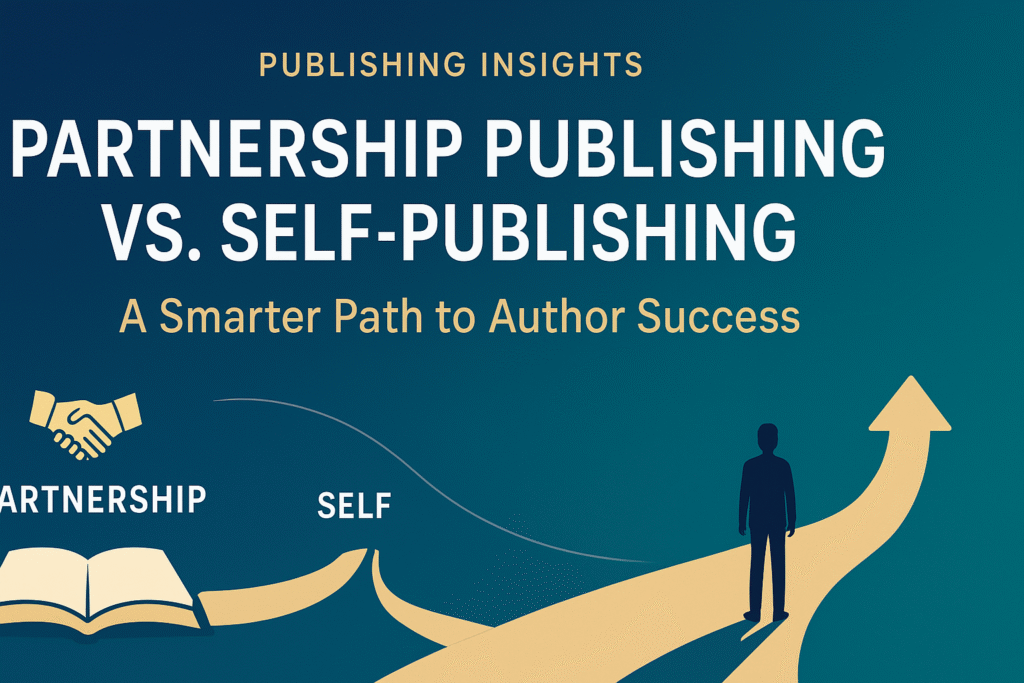
The publishing industry has undergone a massive transformation over the past decade. With digital platforms, print-on-demand services, and global distribution networks, authors have more publishing options than ever before. Traditionally, publishing was dominated by big publishing houses, leaving little room for new authors. However, the rise of self-publishing opened the doors for writers to publish their work independently. While this gave authors full control, it also meant they had to handle every aspect—from editing and cover design to marketing—on their own. Amid these two extremes, partnership publishing has emerged as a hybrid model, blending the strengths of both traditional and self-publishing. It allows authors to retain creative control while gaining access to professional services and distribution channels usually reserved for traditionally published authors. In this article, we’ll explore why partnership publishing can be a smarter, more sustainable choice than pure self-publishing, especially for authors serious about building a professional brand and reaching a global audience. 2. What Is Partnership Publishing? Partnership publishing, sometimes called hybrid publishing, is a model where the publisher and the author collaborateto bring a book to market. Unlike traditional publishing, where the publisher bears all the costs and owns the rights, or self-publishing, where the author bears all responsibilities, partnership publishing strikes a balance. Key features of partnership publishing include: This model appeals to authors who want quality, credibility, and support, but don’t want to give up ownership of their work. 3. What Is Self-Publishing? Self-publishing gives authors full control and full responsibility. Writers manage (or outsource) every stage of the publishing process: While self-publishing offers the highest royalty percentages and complete creative freedom, it also demands significant time, technical skills, marketing knowledge, and financial investment. Many authors underestimate the amount of work required to produce a high-quality book that stands out in a competitive market. 4. Partnership Publishing vs. Self-Publishing: Key Differences Feature Partnership Publishing Self-Publishing Creative Control High (shared decisions with professional input) Complete (author decides everything) Financial Investment Shared or author-funded Fully author-funded Rights & Ownership Usually retained by author Fully retained by author Professional Support Provided by publisher (editing, design, marketing) Author must find and manage freelancers Distribution Reach Global, often through established networks Depends on author’s efforts and platform Marketing Support Strategic marketing included Entirely author’s responsibility Royalties Higher than traditional; often shared Highest percentage but offset by costs Partnership publishing acts as a bridge between the DIY model of self-publishing and the hands-off model of traditional publishing. 5. Benefits of Partnership Publishing Over Self-Publishing 1. Professional Quality and Credibility One of the biggest challenges in self-publishing is ensuring professional quality. Partnership publishers have in-house or vetted teams for editing, design, and formatting, ensuring your book meets industry standards. This boosts your credibility with bookstores, libraries, and readers. 2. Access to Established Distribution Channels Most partnership publishers work with global distributors such as Ingram, Baker & Taylor, Amazon, and regional wholesalers. This means your book can be available in bookstores, online retailers, and libraries worldwide—something difficult to achieve alone. 3. Shared Marketing Expertise Marketing is often where self-publishers struggle the most. Partnership publishers offer strategic marketing campaigns, including press releases, influencer outreach, email marketing, social media planning, and sometimes media coverage. This helps build momentum faster than most authors can achieve solo. 4. Retaining Ownership & Higher Royalties Unlike traditional publishing, you don’t give up your rights. You keep ownership and typically earn 40–60% royalties, which is much higher than traditional deals. This makes partnership publishing both empowering and profitable. 5. Time Efficiency Publishing is time-intensive. Partnership publishing allows authors to focus on writing and brand building, while experts handle the technical, editorial, and marketing work professionally. 6. Strategic Guidance Most partnership publishers offer consultations and publishing strategies tailored to the author’s goals. Whether you want to build a career, reach niche markets, or create a legacy book, you’ll get personalized guidance—something self-publishing platforms rarely provide. 6. Cost Considerations It’s important to be realistic: partnership publishing often involves upfront costs, just like self-publishing. However, the value lies in the professional services provided. Instead of hiring multiple freelancers separately, you work with one experienced team. This can actually be more cost-effective in the long run, especially when you factor in marketing and distribution reach. Many partnership publishers offer different packages depending on your goals—ranging from basic editing + distribution to full marketing and branding support. 7. Global Reach and Brand Building Today’s authors aren’t just publishing a book—they’re building a personal brand. Partnership publishing provides the infrastructure to position you as a professional author on the global stage. With strategic marketing, polished presentation, and distribution support, your book can reach readers across continents—whether you’re targeting English-speaking countries, niche genres, or regional audiences. 8. Common Myths About Partnership Publishing Myth 1: It’s Just Vanity PublishingUnlike vanity presses that charge authors without offering real distribution or editorial value, true partnership publishers are selective and provide measurable services. Myth 2: You Lose Creative ControlIn fact, partnership publishing gives you shared control. You’re part of the decision-making process at every step. Myth 3: It’s Too ExpensiveWhile there are costs, they’re often comparable to what authors would spend assembling a freelance team—and the results are usually more consistent and impactful. 9. When Partnership Publishing Is the Better Choice Partnership publishing may be a better fit if: When Self-Publishing May Still Work Best Self-publishing remains a great option if: How to Choose the Right Partnership Publisher Before committing, research thoroughly. Look for: A legitimate partnership publisher will be transparent, selective, and professional—not pushy. Conclusion Both self-publishing and partnership publishing offer authors exciting opportunities to bring their work to life. Self-publishing gives you total control, but it also demands a lot of time, skill, and effort. Partnership publishing, on the other hand, provides a structured, collaborative, and professional pathway, blending the creative freedom of self-publishing with the expertise and distribution power of traditional publishers. For authors aiming to build a sustainable career, grow their readership globally, and produce professional-quality books, partnership publishing often proves to be the smarter, more strategic choice.
The Literary Lounge: Leading the Way in India’s Publishing Industry

In the rapidly evolving landscape of India’s publishing industry, where traditional gatekeepers are being challenged and new voices are emerging daily, The Literary Lounge has positioned itself as a transformative force that bridges the gap between aspiring authors and their publishing dreams. As a comprehensive publishing services provider, The Literary Lounge represents more than just another publishing house—it embodies a philosophy of author empowerment, quality-driven production, and inclusive access to the literary marketplace that is reshaping how books come to life in India. This article explores how The Literary Lounge has established itself as a leader in India’s publishing ecosystem, examining its comprehensive service offerings, author-centric approach, quality standards, and the innovative ways it’s democratizing publishing access for writers across the country. Whether you’re an aspiring author contemplating your publishing journey or a seasoned writer exploring new publishing avenues, understanding The Literary Lounge’s role in India’s literary landscape provides valuable insights into the future of independent publishing. The Evolution of Publishing in India To appreciate The Literary Lounge’s significance, it’s essential to understand the context of India’s publishing transformation. The Indian publishing industry has undergone dramatic changes over the past two decades, shifting from a landscape dominated by a handful of traditional publishers with high barriers to entry to a diverse ecosystem where independent and hybrid publishers play increasingly important roles. Traditional Publishing Challenges For decades, aspiring Indian authors faced formidable obstacles in the traditional publishing world. Securing a literary agent was often the first insurmountable hurdle, followed by the lengthy process of manuscript submissions, frequent rejections, and waiting periods that could extend for years. Even authors who successfully navigated this gauntlet often surrendered creative control, accepted minimal royalties (typically 7-15%), and faced limited marketing support unless they were already established names. The Self-Publishing Revolution The rise of digital technology and print-on-demand capabilities sparked a self-publishing revolution that offered authors unprecedented control and higher royalty percentages. However, self-publishing presented its own challenges: authors became responsible for every aspect of production, from editing and design to marketing and distribution—tasks requiring skills, time, and resources many writers lacked. The Hybrid Publishing Solution Into this gap stepped innovative publishers like The Literary Lounge, offering hybrid and assisted publishing models that combine the best elements of traditional and self-publishing. These models provide professional publishing services while maintaining author control, reasonable royalty structures, and faster time-to-market—creating a sweet spot that appeals to the growing community of independent authors in India. The Literary Lounge: A Comprehensive Publishing Partner The Literary Lounge distinguishes itself through a holistic approach to publishing that addresses every stage of the book creation and distribution process. Rather than offering piecemeal services, the company provides end-to-end solutions that transform manuscripts into professionally published books available through major distribution channels. Core Service Offerings Professional Editing Services: Quality editing forms the foundation of any successful publication. The Literary Lounge’s editorial team offers multiple levels of editing to ensure manuscripts meet professional standards: This multi-tiered approach ensures that every book published meets high editorial standards, protecting both the author’s reputation and The Literary Lounge’s brand quality. Cover Design and Interior Formatting: In the competitive book market, professional presentation is non-negotiable. The Literary Lounge’s design team creates: The emphasis on professional design ensures books compete effectively with traditionally published titles in both physical and digital marketplaces. ISBN Registration and Copyright: Navigating the administrative requirements of publishing can intimidate new authors. The Literary Lounge handles: This comprehensive administrative support allows authors to focus on writing while ensuring their books are properly registered and protected. Print Production: The Literary Lounge offers flexible print solutions accommodating various budgets and market strategies: The ability to choose between POD and offset printing provides authors with flexibility to match their publishing strategy and budget. Distribution Networks: Publishing a book means little without effective distribution. The Literary Lounge provides access to: This multi-channel distribution ensures books reach readers wherever they prefer to shop. Marketing and Promotional Support: Publishing without promotion results in invisible books. The Literary Lounge offers marketing services including: While authors retain primary responsibility for marketing their work, The Literary Lounge provides tools, guidance, and services that amplify promotional efforts. The Author-Centric Philosophy What truly distinguishes The Literary Lounge from traditional publishers is its author-centric philosophy that prioritizes writers’ interests, maintains transparency, and fosters collaborative partnerships rather than hierarchical relationships. Rights Retention Unlike traditional publishing contracts that typically require authors to surrender rights for extended periods (often life of copyright or 7-10 year terms), The Literary Lounge enables authors to retain complete rights to their intellectual property. This means: This rights retention reflects respect for authors as business partners rather than commodities. Transparent Royalty Structures Traditional publishing’s opaque royalty calculations—with complex deductions for returns, reserves against returns, and “net receipts” calculations—often leave authors confused about their earnings. The Literary Lounge offers: This transparency builds trust and ensures authors understand the business side of publishing. Collaborative Decision-Making Rather than dictating terms, The Literary Lounge engages authors in collaborative decision-making about: This collaboration ensures final products align with authors’ visions while benefiting from professional expertise. Personalized Service Recognizing that every book and author is unique, The Literary Lounge provides personalized service rather than one-size-fits-all packages: This personalized approach makes publishing accessible even for first-time authors navigating unfamiliar territory. Quality Standards and Professional Excellence The democratization of publishing through services like The Literary Lounge raises questions about quality control. The company addresses these concerns through rigorous standards that ensure every published book meets professional benchmarks. Editorial Excellence The Literary Lounge’s editorial team consists of experienced editors with backgrounds in traditional publishing, journalism, and creative writing. Their collective expertise ensures: The company’s editorial reputation benefits from maintaining high standards rather than accepting every manuscript submitted. Production Quality Professional production values distinguish published books from amateur efforts. The Literary Lounge’s quality control processes include: These quality controls ensure The Literary Lounge’s books compete effectively in the marketplace. Professional Network The Literary Lounge’s team includes professionals across specialties: This professional network provides authors with expertise typically accessible